
Engineering Universities in Turkey: Rankings & Tuition Fees (2026 Guide)
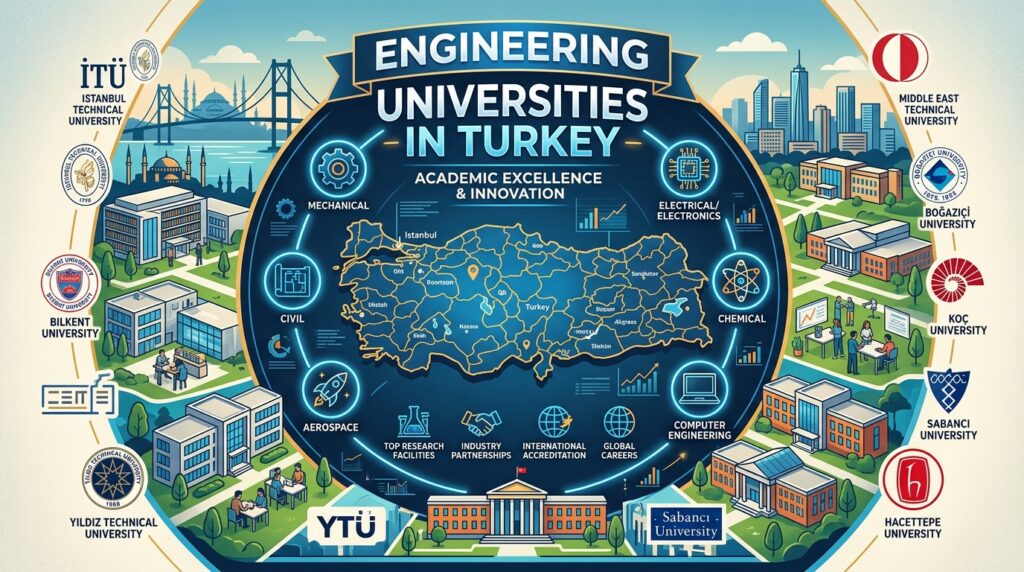
Turkey has emerged as a compelling destination for international students seeking quality engineering education at competitive costs. With several Turkish universities climbing global rankings and tuition fees remaining substantially lower than Western alternatives, the country offers an attractive balance of academic excellence and affordability. This article provides a comprehensive overview of engineering education in Turkey, focusing on current rankings and tuition fee structures for 2026.
Global Recognition: Turkish Universities on the Rise
The 2026 QS World University Rankings by Subject revealed that 11 Turkish universities secured positions within the top 500 across various disciplines . This marks continued progress for Turkish higher education on the international stage, with Quacquarelli Symonds (QS) evaluating more than 1,900 institutions from 100 countries in their most comprehensive study to date .
Top Universities in Engineering & Technology
Makine, elektrik, inşaat ve bilgisayar mühendisliği gibi disiplinleri kapsayan Mühendislik ve Teknoloji geniş alanında, birçok Türk kurumu önemli sıralamalara imza atmıştır:
İstanbul Technical University (İTU) stands out as Turkey’s premier engineering institution. Beyond its 91st place ranking in Engineering and Technology, İTU excels in specific subfields: 39th globally in Petroleum Engineering, 43rd in Mining and Mineral Engineering, and within the 51-100 range for Civil and Structural Engineering . ITU remains the only Turkish university ranked among the world’s top 100 in the Engineering and Technology category .
Other ranking systems corroborate Turkey’s engineering strengths. The Times Higher Education (THE) World University Subject Rankings 2026 placed İstinye University in the 401-500 band globally for engineering, ranking 7th among all Turkish universities in the field . Meanwhile, the SCImago Institutions Rankings 2026 identified İstanbul Gelişim University as 1st in Turkey and the Middle East for Mechanical Engineering, demonstrating specialized excellence beyond the traditional elite institutions .
Understanding Tuition Fees for International Students
Tuition fees vary significantly between public (state) and private (foundation) universities. Generally, private universities charge higher fees but often offer substantial scholarship opportunities, while public universities provide more affordable education with limited scholarships for international students.
Private (Foundation) Universities
Private universities in Turkey typically list their tuition fees in US Dollars for international programs. Fees vary based on the institution’s prestige, location, and available scholarships.
Antalya Bilim Üniversitesi (2026 Akademik Yılı) :
İstanbul Kültür Üniversitesi (2026-2027 Akademik Yılı) :
For graduate studies at İstanbul Kültür University, a Master’s program in Computer Engineering (thesis) costs 4,000totalfortheprogram,whileaPhDcosts7,800 total .
İstanbul Sabahattin Zaim University charges approximately $9,000 for a two-year Master’s program in Electrical and Electronics Engineering, payable in installments .
Public (State) Universities
Public universities are more cost-effective, though their fee structures can be more complex. Boğaziçi University, one of Turkey’s most prestigious public universities, charges international engineering students on a per-credit basis rather than a flat annual fee :
- Engineering faculty credit fee: 630 Turkish Lira (₺) per credit
- Application fees range from 1,170 ₺ to 3,120 ₺ depending on timing
Since most engineering programs require approximately 30 credits per academic year, the annual tuition would be roughly 18,900 ₺ (approximately $580-650 USD depending on exchange rates), making public universities exceptionally affordable for international students.
What Explains the Price Difference?
The dramatic variation between public and private university fees reflects Turkey’s higher education philosophy. Public universities are heavily subsidized by the state, keeping costs low for both domestic and international students . Private foundation universities operate independently and must cover operational costs through tuition, though many offer tiered scholarship systems that can reduce fees by 50-60% for qualified international applicants .
Factors Supporting Engineering Education in Turkey
Several factors enhance the value proposition of Turkish engineering education:
English-Medium Programs: Most top engineering programs, particularly at İTU, METU, Boğaziçi, and leading private universities, are taught entirely in English. İTU maintains its position as Turkey’s only representative in several Europe-wide engineering organizations, including EELISA European University and CESAER .
Strategic Location: Turkey bridges Europe and Asia, offering cultural richness and strategic access to diverse internship and employment markets.
Research Output: SCImago 2026 rankings confirm that Turkish universities are increasing research productivity, with Istanbul Gelişim University ranking 11th nationwide in engineering research .
Accreditation: Many Turkish engineering programs hold international accreditations (ABET, EUR-ACE, MÜDEK), facilitating global recognition of degrees.
Application Considerations
International students should note the following:
- Application Deadlines: Most universities operate on two semesters (Fall and Spring). Fall intake applications typically close between May and August .
- Scholarship Opportunities: Private universities offer automatic consideration for merit-based scholarships; early application often secures better rates .
- Recognition of Prior Learning: Turkish universities generally accept international qualifications (IB, A-Levels, high school diplomas) subject to YÖK (Council of Higher Education) approval .
- Living Costs: Monthly expenses in İstanbul range from $400-800 USD, significantly lower than London, New York, or Sydney.
Conclusion
Turkey’s engineering education sector presents a compelling option for international students. The country’s top institutions – particularly İTU, METU, Boğaziçi, and Koç – continue gaining ground in global rankings, with İTU securing a top-100 position in Engineering and Technology . Simultaneously, tuition remains accessible, ranging from approximately $8,000-9,000 USD at private institutions before scholarships.
For prospective engineering students balancing quality and cost, Turkey deserves serious consideration. The combination of improving global rankings, English-medium instruction, and affordable fee structures positions Turkish universities as increasingly competitive players in international higher education. Students should research specific programs carefully, apply early for scholarship consideration, and verify current fees directly with their chosen institutions, as exchange rates and university policies can change.